
Overview
A Golden Record is more than just a consolidated row of data; it is accompanied by rich Metadata that provides context, history, and trust.
UnifyApps automatically captures and displays this metadata to ensure full transparency.
Whether you are auditing a specific record or troubleshooting a data discrepancy, understanding this metadata is key to tracing the "who, what, and when" of your master data.
Record-Level Metadata
The main Records dashboard provides high-level metadata that helps you assess the overall status and origin of an entity instance.
Record ID: The unique system identifier assigned to the master record (e.g., CUST509). This serves as the permanent handle for the record within the UnifyApps platform.
Contributing Sources: A visual array of icons representing every external system that has fed data into this record. Seeing multiple icons (e.g., MySQL, Salesforce) confirms that the record is a composite of multiple sources.
Lifecycle Timestamps:
Created On: The exact date and time the Golden Record was first initialized.
Last Updated On: The timestamp of the most recent modification, allowing for quick identification of stale vs. fresh data.
Field-Level Metadata (Lineage)
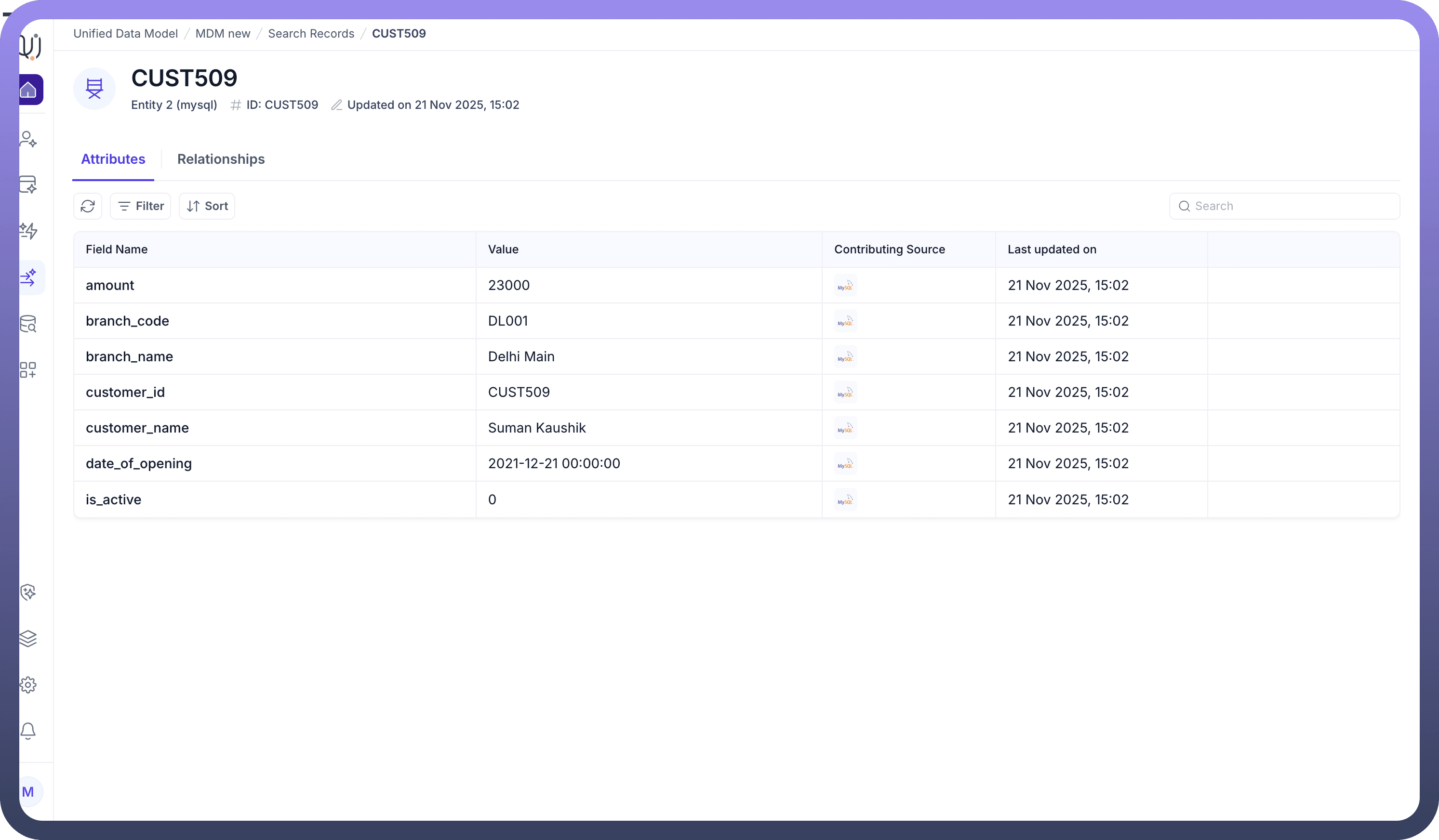
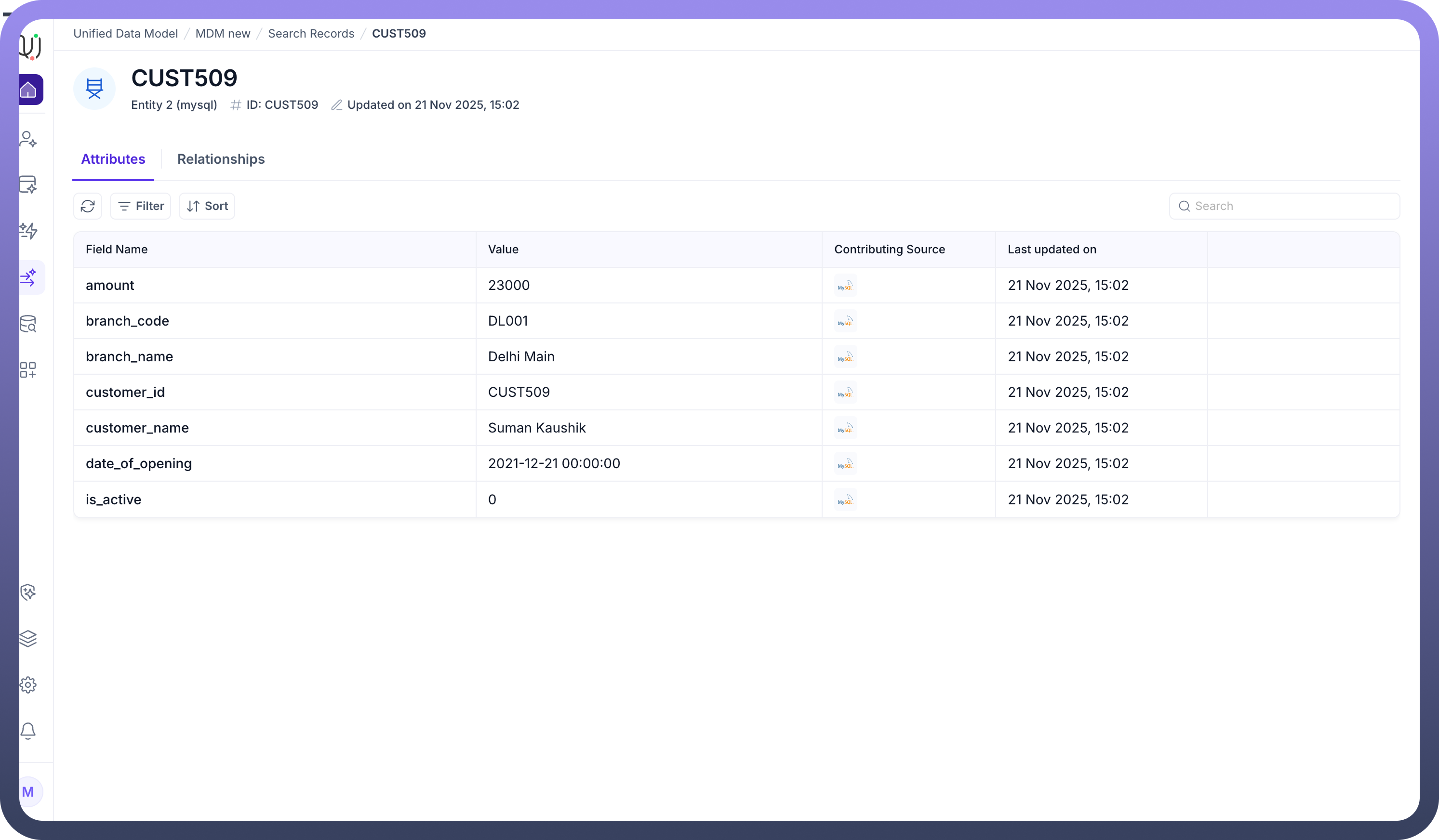
Drilling down into a specific record reveals the Data Lineage for every individual attribute. This granular metadata proves why a specific value was chosen during the survivorship process.
Value Attribution: Next to every data point (e.g., "Delhi Main"), the system displays the specific Contributing Source that provided that exact value.
Update Frequency: Each field has its own Last updated on timestamp.
Audit Context: This enables precise auditing. For example, you can see that while the Customer Name was last updated by Salesforce yesterday, the Phone Number was last updated by MySQL two weeks ago, confirming that the Golden Record is correctly maintaining a hybrid view of the truth.